Tuesday, December 26, 2017
Manu Larcenet - Le Rapport de Brodeck 1/2 & 2/2 (Dargaud, 2017) ****
Als fan van stripverhalen, zou ik nog een blog kunnen beginnen, maar dat laten we voorlopig maar achterwege. Vandaar deze ene bespreking van een "stripverhaal" in deze literatuurrubriek.
We hebben "Le Rapport De Brodeck" van Philippe Claudel al enkele jaren geleden besproken en geprezen: een heel donker verhaal over verraad, loyauteit en angst. Het is nu in een grafische roman omgezet door de Franse striptekenaar Manu Larcenet, die we kennen van strips als "De Dagelijkse Worsteling" (echt niet mijn ding) of als mede-illustrator van de Donjon-reeks.
In de twee volumes van Le Rapport De Brodeck overtreft hij zichzelf. Hij brengt de roman tot leven zoals het zelden is gebeurd. Zijn stijl is uiterst fijn en grof tegelijk, met veel zin voor de kleinste details, die sterk contrasteren met de ruwheid en het gebrek van harmonische vormgeving van de gezichten. De waarheidsgetrouwheid waarmee dieren worden afgebeeld wordt omgezet in verwrongen en duistere overdrijving wanneer mensen worden afgebeeld. Het geheel is somber, ijselijk, dreigend. Elke tekening verdient aandacht. Hij slaagt er ook in om bladzijden zonder tekst te hebben, met een bijna cinematografisch beeldvorming van landschappen en het dorp, maar ook van gebeurtenissen in het dorp zelf.
Hij heeft ook de structuur van de roman van Claudel gerespecteerd, door de huidige tijd te doorweven met flashbacks uit verschillende tijdsmomenten.
Het geheel is verbluffend. Een klein meesterwerk van de "graphic novel". Niet te missen.
Richard Dawkins - Silence In The Soul (Bantam Press, 2017) **
Needless to say, they are all about biology, Darwin, science and religion, including his usual attacks on intelligent design and other non-scientific aberrations.
Interesting to read, but it gives the impression that the publisher needed some more revenue from a best-selling author. Most of the texts do not add anything to Dawkins's other books.
Darren Oldridge - The Devil, A Very Short Introduction (Oxford, 2012) ***
There is no mythical figure more interesting in the history of mankind than the devil himself, the dark one, the evil one. Understanding the creation of the figure and his transformation over the ages is the subject of this little book, just over one hundred pages (without bibliography, notes and index).
The complexity and the ambiguity of the devil was already clear to me as an 8-year old, who was punished in my catholic school for claiming that the devil was actually God's servant instead of enemy, with the argument that if he was God's enemy, he would not punish the wicked ones in hell, but rather set them free again, just to counter God's plans. If what the religion teacher said was right, and the devil would help to keep sinners burn in hell for ever, he was nothing less than God's accomplice.
And that's partly how the figure evolved, as the fallen angels in the jewish texts of the 3rd and 2nd Century BC, and later introduced as God's opponent and evil enemy in the New Testament. Apart from some possible references in the books of the Old Testament, the devil hardly appears at all. He reached the status we currently attribute to him only with the Book of Revelation, written in the second century CE. Some early views even claim the concept of Jesus giving his life for our sins, is part of a deal with the devil. He offers himself to the devil, so as to liberate the rest of humanity.
The visual figure of the devil was further refined based on more eastern mythology of demons and other descriptions. But even then, deep into the middle ages, there was still a concensus among theologists that the devil needed a proxy body to interact with humans. There was less concensus about whether the devil could create offspring with humans. The concept of human evil was definitely placed outside of a person's will, and were, according to Saint Thomas Aquinas nothing less than the devil interfering with the body fluids of a person, in this way creating the wrong mental images and urges, "sometimes in those asleep, sometimes in those awake".
If nothing else, Oldridge's book is exactly what it says it is: a short introduction to the idea of the devil, and for a general and interested audience, it serves its purpose.
Jonathan Haidt - The Righteous Mind (Penguin, 2012) ***½
American cultural and social psychologist Jonathan Haidt's "The Righteous Mind" has become a standard in moral and political psychology. Haidt describes how - in the context of politcal thought and morality - judgments are made intuitively, with reason serving as the rationale to describe our judgment 'a posteriori', and not the other way round. We only appear to be rational beings when judging, in reality our judgment is made on the basis of a number of personal, emotional and group influences.
He gives a lot of examples of psychological tests in which the participants gave justifications for their behaviour afterwards, not based on reason. He explains that our social world is "Glauconian", named after the brother of Plato, who argued that people behave morally or just, only because they are kept in check by the social group to which they belong, by appearances and reputation.
Haidt guides us through the implications of cultural bias to assess morality, and he explains how we need to expand our typically liberal view of morality with the broader moral base that many cultures across the world have.
He breaks them down into five categories
- the Care/Harm foundation
- the Faith/Cheating foundation
- the Loyalty/Betrayal foundation
- the Authority/Subversion foundation
- the Sanctity/Degradation foundation
... in which the first two are typically the strongest among liberal voters and the latter three more dominant among conservative voters. If you want to know where you are positioned, you can do the test yourself on his website.
Here are my test results, high scores on care and fairness, low scores on loyalty, respect for authority and sanctity.
But of course that's not the point of the book, even if every participant adds new data to his survey. Haidt's insights and approach shed some light on how our world functions today. Indeed, the question of moral choices is one of everyday politics and debates. Understanding why choices are made, and understanding the dynamics behind them are critical. What he does not do in the book is to dig a level deeper, namely to assess the psychology of the people who make these moral choices. Are there any common traits among these five foundations (insecurity, fear, dominance, control, ...).
One aspect of Haidt's approach is that it predicted the chances of Trump to win the presidential election. For the simple reason that all democrats always have a discourse that is focused on care and fairness, yet it totally ignores the three other foundational elements. The Republican party has invested more in topics such as loyalty to "our country", to "our religion", to "our sexual ethics", etc.
Food for thought ...
Julian Baggini - A Short History Of Truth (Quercus, 2017) ***
Julian Baggini is the founding editor of The Philosophers' Magazine. He has a PhD on the philosophy of personal identity and is the author, co-author or editor of over twenty books.
In "A Short History Of Truth", he touches in a very light and welcoming style the different types of truth that exist out there, including the truths that are claimed to be eternal, authoritative, esoteric, reasoned, empirical, creative, relative, powerful, moral or holistic. He explains all of them with their inherent challenges and paradoxes, the way they have been used and abused. All this in about 100 pages of easy to read philosophy.
Getting to know the truth is a question of attitude. "Establishing the truth requires epistemic virtues like modesty, scepticism, openness to other perspectives, a spirit of collective enquiry, a readiness to confront power, a desire to create better truths, a willingness to let our morals be guided by the facts".
It sounds so simple, this question of attitude. If it is so simple, why is it so difficult?
David Wootton - The Invention Of Science (Penguin, 2015) ****
David Wootton's "The Invention of Science", has a very appropriate subtitle: "A New History of The Scientific Revolution".
Wootton is a professor of history at the University of York, who has done a lot of actual research by reading the old manuscripts first-hand, which allows him to come with very detailed accounts of how scientists since the renaissance thought about their world they gradually started discovering, but at the same time he has this broad sweeping vision of discoveries and evolutions in a variety of disciplines to give the big picture as well.
He starts by explaining how until 1492, the year of Columbus's "discovery" of the Americas, every intellectual was of the opinion that everything there was to know, was actually already captured in the scriptures and in the texts of the ancient Greeks, with Aristotle as their number one source. Intellectual work was often limited to understanding these texts better, or interpreting them differently. Columbus's discovery came as a shock, because it was evidence that the world was a different place than actually thought, and that not everything was already written. It even changed the concept of time and the concept of progress, since many medieval people, did not consider the Romans or the ancient Greeks as more technologically backward. They were just people living at another time, just as they were living in another place. The idea that new technology could improve things, was not very high on the agenda.
And actually, many of the new discoveries came from the mundane and military. Telescopes evolved from monoculars to watch ships, physics partly evolved from calculating the ballistic trajectory of cannon balls, how double bookkeeping changed the way to represent data, etc. Brahe, Galileo, Copernicus, Bruno, Newton, ... of course all come into the picture, in a way that is both known and new, because Wootton expertly describes what these great scientists thought and felt about their own discoveries, how they struggled, also internally, with the shifting reference frameworks to look at reality.
He expands quite a lot on the simple aspect of using "fact" as evidence, a concept which was totally alien to the world before the early 'modern age'. He describes how experiments were made to test the validity of theoretical assumptions, again something that shattered the words in the books of for instance Galenus. Observation and testing suddenly got valued, and the first experiments with the vaccuum paved the way to create the barometer.
Obviously all this is further increased through the creation of scientific communities, who no longer only needed to write letters to each other, but who, thanks to the invention of the printing press, could share their insights more broadly, generating interest and inviting in comments from many more people to collectively move a better understanding forward. Despite this, the time frame within which new discoveries were accepted as scientific evidence could take and did take much more time than it does today. For instance, Newton's 'Principia' on his discovery of gravity, was first published in 1687, but resistance against his findings continued until the 1740s by other eminent intellectuals such as Huygens and Leibniz.
It's a long book, 570 pages with another 200 of notes, bibliography and index, but amazingly interesting and well written. Wootton knows so many little details about the tests, the personal opinions of the scientists to make it read like a novel. He is also a master in explaining the other side of rational thinking, that was equally part of the world in which science evolved: astrology, alchemy and witchcraft, and other bizarre theories about how our body and our world function.
It is only through this lens that Wootton offers us that we can really understand what progress actually means, and how our current world view has struggled to emancipate itself from the obscure, bizarre, dangerous and sometimes funny worldviews of the past.
A book to read when you have lots of time.
Carlo Rovelli - Reality Is Not What It Seems (Penguin, 2017) ****
In this great book, physicist Carlo Rovelli explains what we know about reality, and how it can be interpreted. It's a wonderful journey into the nature of science itself, about what we know and don't know, and about what we can know. In our universe there are one billion galaxies with each around 1 billion stars, and our world is just one planet of those stars. In the middle of our galaxy, there is a black hole that is one million times the size of our sun, and that swallows up entire "solar systems" like a whale eats little fish (I checked this, and they do eat small fish, and not only plankton, which I thought).
He gives an overview of a number of theories that are currently used to describe the facts and findings of modern physics. What comes out loud and clear is that our universe is finite.
Rovelli gives a historic overview of theories about our world, and how they involved over time. He does this in a very readable and accessible way, often using anecdotes and discussions from the life of the physicists who shaped our current thinking.
Rovelli ends the book with some musings on the nature of science. He says that the only thing that's infinite is our ignorance. And that's maybe a good thing too. "Science is not reliable because it provides certainty. It's reliable because it provides us with the best answers we have at present. Science is the most we know so far about the problems confronting us. It is precisely this openness, the fact that it constantly calls current knowledge into question, which guarantees that the answers it offers are the best so far available."
There is a lot we don't know yet. And that's a message which still offers mystery and humility.
Lawrence Krauss - A Universe From Nothing (Simon & Schuster, 2012) ****
Why is there something rather than nothing? The major question that has been driving philosophical thought and theology for thousands of years.
Lawrence Krauss tries to give a glimpse of what might look like an answer. And if anybody can know, it's him. With degrees of physics of MIT and Harvard, he is now professor of cosmology at the University of Arizona.
He gives many examples of things that come to existence from nothing, which is really common at the level of the smallest components of our quantum world. And because the big universe out there is only an assembly of these small particles, there is no need for a cause to exist. That is just the way it is. "Ultimately, this question may not be more significant or profound than asking why some flowers are red and some are blue".
Obviously, before getting there, Krauss takes us on an interesting - and often personal - journey, creating a big picture of insights from quantum physics to the consequences of this weird world for a better understanding of our universe. He explains it in a layman's language, without any need for prior understanding of mathematics or physics. Nevertheless, it remains quite a feat to grasp the latest theories, for the simple reason that it's impossible for us to picture them with our macro-world perspective. How can you understand what a "multiverse" might look like. Or how can you understand a closed universe, one in which if you could see far enough, you would be looking at the back of your own head? How can you understand anti-matter?
One thing is certain for him. Even if we do not understand all aspects of our world and universe, there is no need for a "god" to have created it. There is not only no need for it, it would make the whole even more complex and more unlikely.
Interesting reading if you're interested in the most profound question of our existence.
Friday, July 28, 2017
Robert Hazen - The Story Of Earth (Penguin, 2012) ****
This is nothing less than amazing. Mineralogist Robert Hazen explains the painstaking effort of collecting rocks and minerals, and then painstakingly analysing them all under a mass spectrometer and then cataloguing them and organising them and thinking about what it all might mean. Thousands and thousands of pieces of rock from all over the world. What you can do with it sounds simple, to reconstruct the history of the earth, the full 4.5 billion years it exists. You get a wonderful chronological journey from day one till now and with some wise words for the future to conclude.
Everything that ever happened on our planet of any significance is captured in the minerals around us: the chemical properties of basic elements, the level of oxygen in the air, the eruptions, the collisions, the moving of the continents, the arrival of life, the state of the atmosphere, the change in the magnetic field of the earth, the brutal differences in temperature, etc, etc.
It is nothing but spectacular, and sure the object itself is incredible, but how Hazen writes with passion about his field of study is equallly amazing, with the right level of explanation to make it understable for non-geologists but I guess that specialists will also find it rewarding to read about their subject in layman's language.
Fascinating!
... and then you wonder about the morons who think the earth is 6,000 years old. How is it possible that major scientific work never reaches the masses?
Everything that ever happened on our planet of any significance is captured in the minerals around us: the chemical properties of basic elements, the level of oxygen in the air, the eruptions, the collisions, the moving of the continents, the arrival of life, the state of the atmosphere, the change in the magnetic field of the earth, the brutal differences in temperature, etc, etc.
It is nothing but spectacular, and sure the object itself is incredible, but how Hazen writes with passion about his field of study is equallly amazing, with the right level of explanation to make it understable for non-geologists but I guess that specialists will also find it rewarding to read about their subject in layman's language.
Fascinating!
... and then you wonder about the morons who think the earth is 6,000 years old. How is it possible that major scientific work never reaches the masses?
Juan Gabriel Vásquez - Reputations (Bloomsbury, 2016) ****
Juan Gabriel Vásquez weaves the remembering and the present into a fine, subtle and sensitive texture of questioning of his own achievements, the power of the media, the abuse of power, the fragility of life, and the shifting perspectives between being prey or predator.
His style is an interesting mixture of Milan Kundera (the questions, the distant observation of his characters, ...) and Javier Marias (the long sentences, the shifting interior musings, ...) and both trying to come to grips with a reality that is hard to understand and fathom, while at the same time very recognisable and intimate.
A really strong novel, written with a wonderful sense of composition, sensitive characters and wit.
Michael Chabon - Moonglow (4th Estate, 2016) ****
With Moonglow, he moves into new territory for him, namely the life of his grandparents, as told by his grandfather on his deathbed, and at the same time the story of the weight of being jewish.
His grandfather was a rocket engineer and one of the first people to have entered Nordhausen at the end of the Second World War, the place where the V-2 rockets were being produced. Pynchon's "Gravity's Rainbow" comes to mind, and is even mentioned several times in the novel, but apart from the historical context, there is no other comparison. Chabon's prose is direct, precise, unusually without any demonstration of stylistic prowess, almost as the chronicler of events, even if once in a while you can read wonderful sentences such as "got his grandfather so drunk that he was able to directly experience, if not communicate, some of the unlikelier effects on time and space called for by Einstein's Special and General Theories of Relativity"
Yet he goes further, much further, actually reconstructing the lives of his grandparents - and parents - by adding a strong dose of fiction of their daily lives, the conversations, the details of clothing, behaviour and thoughts that no person could ever remember, let alone fully recount during the last days of one's lives. This creates an almost obscene intimacy, by putting yourself in the position of these people you probably knew so well, including the sexual longing and sexual acts.
The book is as much about the grandfather's fight and moral concerns about German rocket scientist Werner von Braun and his gang, who participated in the US space programmes, and even more about his grandmother, a French jewish refugee, an actress with a great joie-de-vivre, and independent thoughts and action, who increasingly becomes the victim of schizophrenia. It is about his grandfather's attempt to build a new relationship after his grandmother has died.
Both grandparents are damaged goods, yet they try to live together as almost totally opposing forces: he is the principled engineer with a strong sense of ethics, who even spends a year in prison for an impulsive physical attack on his employer, she is the artist, the beautiful woman who lives in a world of fantasy and fear, using tarot cards with her grandson. Despite the differences between them, there is love and deep respect, even if they are fully aware of each other's shortcomings.
The whole novel is pieced together in a very non-chronological form, with memories, pictures and additional detail provided by his mother as elements to reconstruct something that will always be a little less than what it was, yet paradoxically, it's the novelists fictitious additions that make the people come to live, and maybe even make it bigger and more moving than it actually was.
Peter Stanford - The Devil - A Biography (Arrow, 2003) ***
There was not much place for the Evil One in the Old Testament, since God himself was portrayed as booth good and evil, merciful and vengeful. It is only in the New Testament that he becomes a real character, albeit still a vague presence.
Gradually, over the centuries, he started collecting physical characteristics, to become the horned figure we see in horror movies, with influences from other religions and popular folk tales. No depiction of him even exists before the sixth century. And in popular beliefs, strongly influenced by the church, he became a real presence in people's everyday life over the centuries, and now gradually being reduced back to the fantasy figure he always was to the realm of fiction and movies.
It is fascinating to read how he has been used over the centuries, how he instilled fears in uneducated populations. In sermons some hundred years ago, he was still often mentioned in Europe. I think he has even completely disappeared from all sermons these days in Europe, with the exception maybe of some maverick extremists.
Everything he every embodied, has now been reduced to our human psyche (the internal evil) and to chance happenings (earthquakes, floods). There seems to be no need anymore to blame a distinct person to create and organise all that's unwelcome in society.
Etienne Vermeersch - Over God (Vrijdag, 2016) ***
Van de weinige intellectuelen die ons land rijk is, denk ik dat ik vooral voor Etienne Vermeersch de grootste achting heb. Hij durft niet alleen standpunten innemen, maar hij slaagt er ook in om die helder te onderbouwen, met tegelijk een goede tegenargumentatie voor alle punten die zijn betoog zouden kunnen tegenspreken. In televisiedebatten heeft hij alle standpunten van zijn tegenstanders al grondig overwogen voor hij naar de studio kwam. Dat maakt hem zo sterk. Hij kent alle andere standpunten al, vaak zelfs beter dan degenen die ze uiten. In "Over God" leren we niets nieuws (ik toch niet), maar het korte boekje geeft wel een zeer goed overzicht van de verschillende argumenten die god kunnen reduceren waar hij thuishoort: in het domein van de fictie.
Vermeersch toont aan dat het bestaan van een god op basis van rationele grond niet kan. Maar dat hadden we al begrepen voor we begonnen te lezen.
Jan-Werner Müller - What Is Populism? (Penn, 2016) ***
He describes what populism is and stands for, in its many forms: the only true representative of "the people", the true representatives of moral values, against the immoral elites, against the establishment, waging an apocalyptic war against the secret and oppressing forces. Their enemies are the press, intellectuals and civil society.
He explains how populism is created by the strong democratic deficit of open debate and the rule of technocrats whose language not only doesn not appeal to the general population, but which is also not directed to them. Specifically in the US, the economic interests of a significant part of the population is underrepresented in Washington.
When populists gain power, they will, interestingly enough, not bring politics "closer to the people" or even reasserting popular sovereignty.
He mentions a number of solutions, which is of course a much more open and public debate on the topics that are on people's minds, including a good democratic representation (but not through referenda!).
Julian Barnes - The Noise Of Time (Vintage, 2016) *****
The theme is about the balance between authentic artistry and survival, between coming up for your ideas and ideals, while trying to stay alive in a very hostile environment. He yields and stays true to himself. Barnes' account of the composer's life is built around memories of situations, not always chronologically, nor even logically, but as little vignettes that gradually present his feelings, his remorse, his doubts, his moral musings, placed in the context of history.
It is a novel about the individual survival within the system he abhors. It is about authenticity and untruth, the constant lies by the Power, the propaganda and their so-called moral superiority ... and later the fact that becomes a puppet for the Soviet system, and tries to avoid it. Shostakovitch is not a hero in the traditional sense, and even the very concept of "hero" gets undermined: "But these heroes, these martyrs, whose death often gave a double satisfaction - to the tyrant who ordered it, and to watching nations who wished to sympathise and yet feel superior - they did not die alone. Many around them would be destroyed as a result of their heroism. And therefore it was not simple, even when it was clear".
His only heroism is to be true to himself and his music: to create something that would survive him, the music that would say everything there is to tell, that is more and better than dying as a martyr, but also this comes at a price:" 'He could not live with himself'. It was just a phrase, but an exact one. Under the pressure of the Power, the self cracks and splits. The public coward lives with the private hero. Or vice versa. Or, more usually, the public coward lives with the private coward. But that is too simple: the idea of a man split into two by a dividing axe. Better: a man crushed into a hundred pieces of rubble, vainly trying to remember how they - he - once fitted together."
This novel is brilliant because of its style, its composition, its tone and lack of answers, its sensitive rendering of internal and external struggles, its historical value and insight in human nature.
Exquisite.
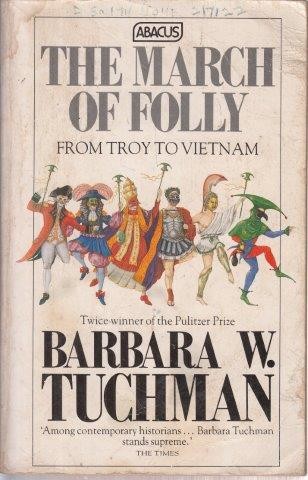
Barbara Tuchman - The March Of Folly (Abacus, 1984) *****
What is the March of Folly - it is the stupidity of those in power to create their own downfall when all the indicators demonstrate what is going to happen. Despite all the warnings, including from friends and close allies and counselors and advisors, the men in power still decide to move forward with their mad schemes, which will enexorably to their dawnfall.
The theme is the legend of the Trojan Horse, pulled inside Troy when filled with Greek soldiers who come out at night to open the gates so that the army can invade the city after so many years of battle. Did not all the Trojans warn not to bring the horse into the city? Yes, of course, but when stupidity reigns, it will not listen to reason.
The other historic moments to illustrate the March of Folly are the catholic popes of the 15th and early 16th century, who rule like modern day dictators, unhindered by any moral or ethical considerations, but lusting for sex, money and power. Instead of making the church more powerful, the exact opposite happened, and half of Europe turned its back on catholicism.
The second historic moment is how the Brits lost America as its land across the ocean. Tuchman describes in detail how stupidity and ignorance were the key characteristics of the politics in London at that time. "The attitude was a sense of superiority so dense as to be inpenetrable ... the (successive) ministries went through a full decade of mounting conflict with the colonies without any of them sending a representative, much less a minster, across the Atlantic to make acquaintance, to discuss, to find out what was spoiling, even endangering, the relationship and how it might be better managed".
The last example is about the United States' desperate attempts to win the Vietnam war, and when everybody saw the stupidity of what was happening, the needless bloodshed, the hundreds of thousands of victims, the United States government still kept moving forward to an inevitable loss. As the French General Leclerc said to his political advisor prior to the war 'it would take 500,000 men to do it, and even then it could not be done'. The amount of men sacrificed was indeed an underestimation.
In the current world, with other madmen ruling the world: Trump and Putin for the major powers, and many other of a minor order, yet equally mad, such as Erdogan, Duterte, Maduro, Kabila, Mugabe, to name just a few, the book remains a strongly recommended read.
Listen to these sentences, "When private interest is placed before public interests, and private ambition, greed and the bewitchment of exercising power determine policy, the public interest necessarily loses" or "Personal self-interest belongs to every time and becomes folly when it dominates government" or "Their three outstanding attitudes - obliviousness to the growing disaffection of constituents, primacy of self-aggrandizement, illusion of invulnerable status - are persistent aspects of folly" and know they refer to the popes of the 15th century, they are still equally valid for many of the rulers of today.
And as a final comment: this history book reads like a novel. She writes with passion, not hiding her own opinion. In that sense it's more of a pamphlet, albeit a hefty one, but one that is crammed with facts as it should be for a well-researched history book. Of course you know what's going to happen, and the fact that the cases are so extreme, the stupidity so overwhelming, the human cost so high, make the novel all the more important today.
Barbara Ehrenreich - Dancing In The Streets (Granta, 2007) **
Keep dancing!
Amos Oz - Judas (Chatto & Windus, 2016) **
Shmuel Ash is a jewish student in the Jerusalem of 1959, and although he was writing a university text on early christianity and the role of Judas, he drops out and becomes the assistant of an old man, to keep him company when the old man requires. Shmuel falls in love with the old man's 40-year old lively yet mysterious daughter-in-law, Atalia Abravanel. Her deceased father used to be one of Israel's traitors, a man who advocated for one single state under international control where jews and arabs could live together. As a vocal anti-zionist his named and reputation had been smeared. Like Judas, he was the traitor of his own heritage and culture.
The concept of the novel sounds good. Different layers are at work, past and present, myth and reality, personal lives and historic facts, with often differences in perspectives, including during the long discussions between Shmuel and the old man. The shifting perspectives on the concept of traitor of course also surface. Was Judas a traitor, or was he the one without whom the crucifixion and resurrection could not have taken place?
So far so good, but all this does not make the novel really a strong literary achievement. The characters are dull, with the exception of Atalia, the story is without inherent tension, and stylistically it is not very special. What remains is a novel of ideas. Strangely enough, the deep sense of anger caused by betrayal, the confusion it creates, the uncertainty about whether or not to go against the own group, the cowardice or courage are all very strong and deep emotions that deserved a better story than the one offered. But maybe that's just another layer. That the distant reporting by the uninteresting characters is in itself a betrayal of the deep personal human crisis that betrayal constitutes.
Christian Kracht - Imperium (Farrar, Strauss & Giroux, 2012) *
In this novel, Kracht reconstructs the life of the excentric man, telling his arrival in New Guinea, the creation of his plantation, his local servants on the island, his interactions with the authorities and other Germans on the main land. Somehow it fails to make the person really come to live. Kracht depicts his main character with a kind of detached superiority, instead of really trying to understand the man's motivations, actions and ensuing insanity. At times it made me think of that other bad novel "The Confederacy Of Dunces", for the simple reason that the main character is stupid, and you wonder the whole time why a novelist would spend time to ridicule his main character. Why?
Kracht's writing is not bad by itself, and sure, no doubt Engelhardt's vision on life and on diet were pretty narrow, one-sided and doomed to fail, and even the author did a lot to bring historical facts back to us, the condescending tone kills what could have been a strong book.
Howard Bloom - The Genius Of The Beast (Prometheus, 2011) ***
Why I like him is because of his big picture thinking. He brings things together in a way that very few people can, creating links between mass behaviour theories with physics, history and paleontology. I like the way he tries to build grand theories about how abstract processes underly totally different phenomena. I like the way he writes, with passion, without dwelling too much on the details, but steadily dragging the reader on towards new insights and new parallels and new facts. He is strong at giving new perspectives on known realities.
In The Genius Of The Beast, he tries to look at the forces that drive us, our emotions and values to create innovations and a better world, or as the subtitle says : "a radical re-vision of capitalism".
Like a good marketeer, he gives names to his own inventions: he calls itthe "secular genesis machine", the "evolutionary search engine", and the two rules of science: the truth at any cost, including the cost of your life, and to look at what is right under your nose as if it is the first time you have seen it, then proceed from there. He describes how our deepest feelings of personal self-fullfilment combined with empathy will move the world forward, looking for improvements in the culture we create, failing oftentimes, yet moving forward, course-correcting and continuing on the new track. And why capitalism is important, because in the end the consumer will dictate where he or she wants to go, and go for those items that are giving pleasure, that surprise and that create fun. And if there are side-effects, the system will handle those and move forward.
This book, like some of his other books, reads like an endless rant, without clear structure but written with passion. I'm not sure whether you have to take what he writes seriously, clearly he jumps from one subject to the next, finding big analogies between the way molecules work, or beehives, or tribes or complex societies, without any evidence that there is a natural link. Bloom is not a scientist, despite his own claims, but he creates wonderful collages of related and unrelated facts.
If you have a good sense of criticism, some of his ideas may be of interest, and surely challenging some of the thoughts you currently hold, making you think about the topics he writes about. That by itself is already a good result, even if you won't find any conclusive answers.
Subscribe to:
Comments (Atom)